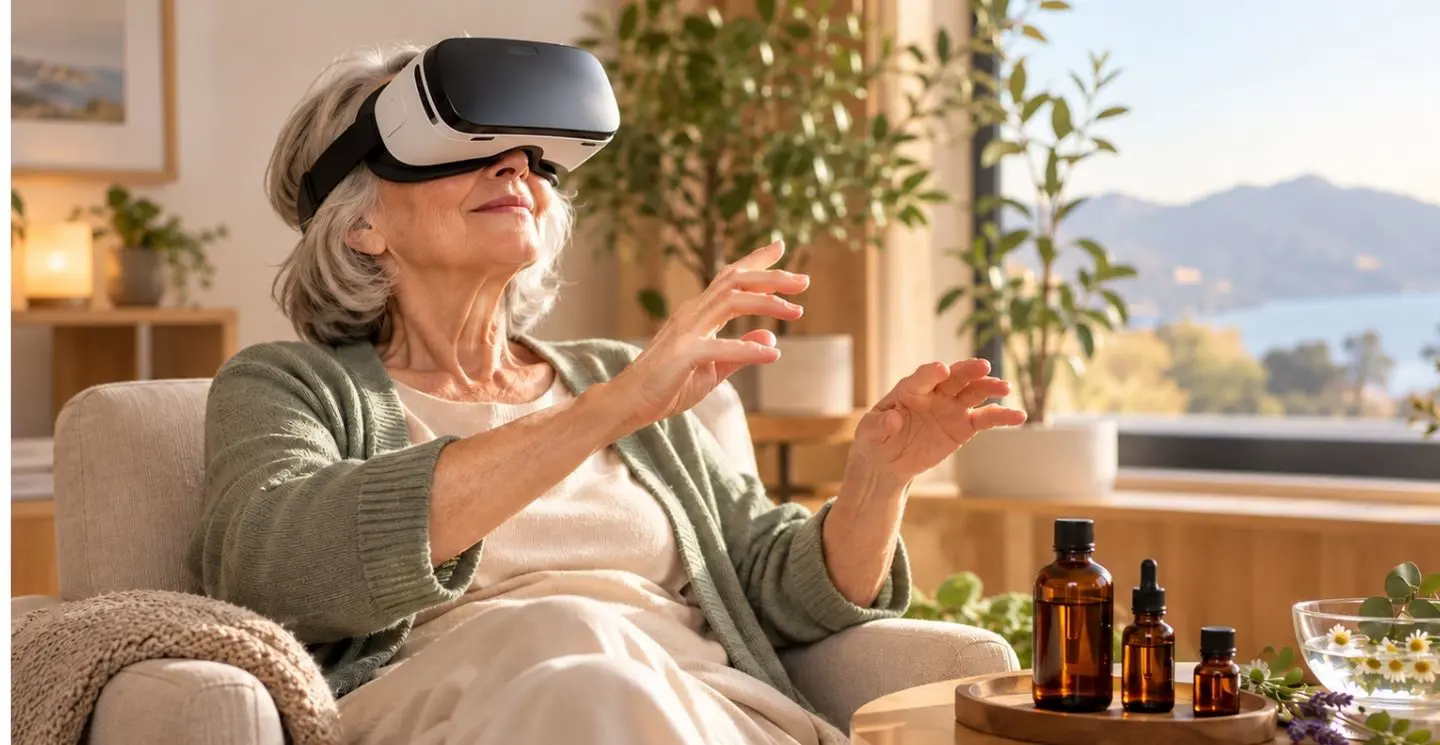
A study published in 2020 explored the combination of virtual reality and aromatherapy through a program involving older adults. The study lasted a total of 9 weeks. One of its notable aspects was that participants were actively involved in the preparation and learning process related to aromatherapy.
As technology transforms many areas of daily life, it also makes it possible to develop new ways of learning and experiencing. One of these, virtual reality technology, is being studied not only for entertainment but also within education- and interaction-focused research. So can technology and aromatherapy be part of the same experience?
A study published in 2020 explored the combination of virtual reality and aromatherapy through a program involving older adults. The study lasted a total of 9 weeks. One of its notable aspects was that participants were actively involved in the preparation and learning process related to aromatherapy.
How Was Virtual Reality Used in the Study?
A total of 60 people over the age of 65, living in two different care homes, took part in the study. Participants were divided into experimental and control groups. Before the program, participants in the experimental group were introduced to virtual reality technology. They learned how to use three-dimensional virtual reality headsets and how to perform simple tasks in the virtual environment.
This was followed by a hands-on training process related to aromatherapy. After learning the process of preparing an aromatherapy product, participants experienced what they had learned in the virtual environment. In this way, virtual reality and aromatherapy were brought together in a single program focused on learning and participation.
Why Was a Virtual Environment Chosen?
With advancing age, hand-eye coordination and certain physical skills can vary from person to person. This can also affect how people take part in hands-on activities. A virtual environment, meanwhile, may allow some stages to be experienced in a different way. In the study, rather than merely listening to explanations, participants became part of the process by interacting with the virtual environment.
In this respect, the study offers an intriguing example of how aromatherapy practices and technology can be considered together in terms of education and user experience.
Active Participation in the Aromatherapy Process
One of the study's highlights was that participants were involved in the process of preparing the aromatherapy product. During the session carried out in the virtual environment, the researchers prepared the same product in the real world and presented it to participants. The digital experience and the physical aromatherapy application thus progressed in connection with each other.
Using various assessment tools, the study compared data from before and after the program. The researchers reported differences between the groups in some of the assessment results. However, these findings should not be regarded as definitive evidence that the aromatherapy application produced any particular health effect. What makes the study notable is its use of an interactive, technology-supported method in an aromatherapy-focused experience involving older adults.
How Might Technology Change the Aromatherapy Experience?
The combination of virtual reality and aromatherapy raises different possibilities for how technology might be used in the field of aromatherapy.
Virtual environments could be considered for purposes such as learning about aromatherapy, becoming familiar with the stages of preparing a product, and enabling users to take part in training processes interactively. Similar technologies may also be used in different ways in the fields of education and experience design in the future.
When using essential oils and aromatic products, the product's instructions for use, recommended method of use and safety warnings should be taken into account. Aromatherapy should not be regarded as a substitute for medical diagnosis or treatment. Research findings should not be interpreted as a definitive health effect or guaranteed outcome for any particular aromatherapy product or practice.
As technology advances, it seems possible that the aromatherapy experience will also be approached in new ways. This study stands as one of the early and intriguing examples in which the intersection of virtual reality and aromatherapy has been explored.
Source
Cheng, V. Y.-W., Huang, C.-M., Liao, J.-Y., Hsu, H.-P., Wang, S.-W., Huang, S.-F., & Guo, J.-L. (2020). Combination of 3-dimensional virtual reality and hands-on aromatherapy in improving institutionalized older adults' psychological health: Quasi-experimental study. Journal of Medical Internet Research, 22(7), e17096. DOI: 10.2196/17096
Shop The Story

Lavender Mailette Essential Oil 10 ml - FINE LAVANDER CHEMOTYPE MAILETTE


Recent Posts
29 September 2026
What Do Essential Oils Smell Like? Discover Their Scent Profiles
15 September 2026
A Look at a Scientific Study on Bergamot Essential Oil